
For leaders in Advanced Engineering, the outlook for 2026 is defined by a clear tension. On the one hand, the European aerospace and defence sector is experiencing an unprecedented pace of technological advancement, coupled with strong order books. On the other, the “human factor” is increasingly becoming the limiting constraint.
As a recruitment partner for highly specialised engineering roles, we at Amoria Bond see this dynamic play out every day. But what do the data say? Drawing on recent analyses from leading institutes and agencies, we have summarised the key developments shaping 2026 — and what they mean for your talent strategy.
Technology Update: From Experimentation to Industrial-Scale Production
The most significant shift heading into 2026 is the move from proof of concept to scalable manufacturing. Germany, in particular, is consolidating its position as Europe’s technological backbone.
Artificial intelligence is no longer a futuristic concept. ESA initiatives — including collaborations with partners such as MT Aerospace in Germany — demonstrate that AI and machine learning are already enhancing day-to-day production processes. They are being used to predict metal deformation, automate quality inspections in welding, and detect defects in composite manufacturing in real time. The Aerospace Industries Association (AIA) likewise confirms that the sector is moving beyond isolated pilots towards organisation-wide adoption, with generative AI holding the potential to reshape entire value chains.
At the same time, Germany is reinforcing its role as a hub for “New Space”. The European Space Operations Centre (ESOC) in Darmstadt remains the sector’s central nerve centre, currently controlling 16 missions and preparing future programmes such as ExoMars. Of particular interest for Germany as a location, ESA has placed its trust in Rocket Factory Augsburg (RFA), with two confirmed missions on the RFA One launcher — further strengthening Germany’s position as an emerging launch services provider.
Insight for managers: The technology is ready. The real challenge in 2026 will not be innovation itself, but the availability of engineers capable of implementing complex AI-driven systems and next-generation launcher technologies.

Market Dynamics: Full Order Books and Growing M&A Activity
From an economic perspective, the signals point clearly towards expansion. Structural market drivers — including rising defence budgets and increasing air traffic — are supporting a positive M&A outlook for 2025 and beyond. We are seeing a growing number of strategic expansions, particularly across defence technology, cyber systems and green aviation.
However, this boom is colliding with a significant bottleneck: a substantial production backlog. There are currently more than 17,000 jets on order, and at today’s production rates it could take up to 14 years to clear this backlog. The shortage of new aircraft is forcing airlines to operate older fleets for longer, in turn fuelling a “super-cycle” in maintenance, repair and overhaul (MRO).
The 300-Million-Dollar Question: The War for Talent
This is where the critical challenge lies for every hiring manager. Today’s production constraints are not driven by supply chain issues alone, but to a large extent by a shortage of experienced specialists and an ageing workforce.
This talent gap is more than an operational frustration — it represents a tangible financial risk. Estimates suggest that the combined impact of skills shortages and slow hiring could cost a mid-sized aerospace and defence company between 300 and 330 million US dollars per year in lost productivity.
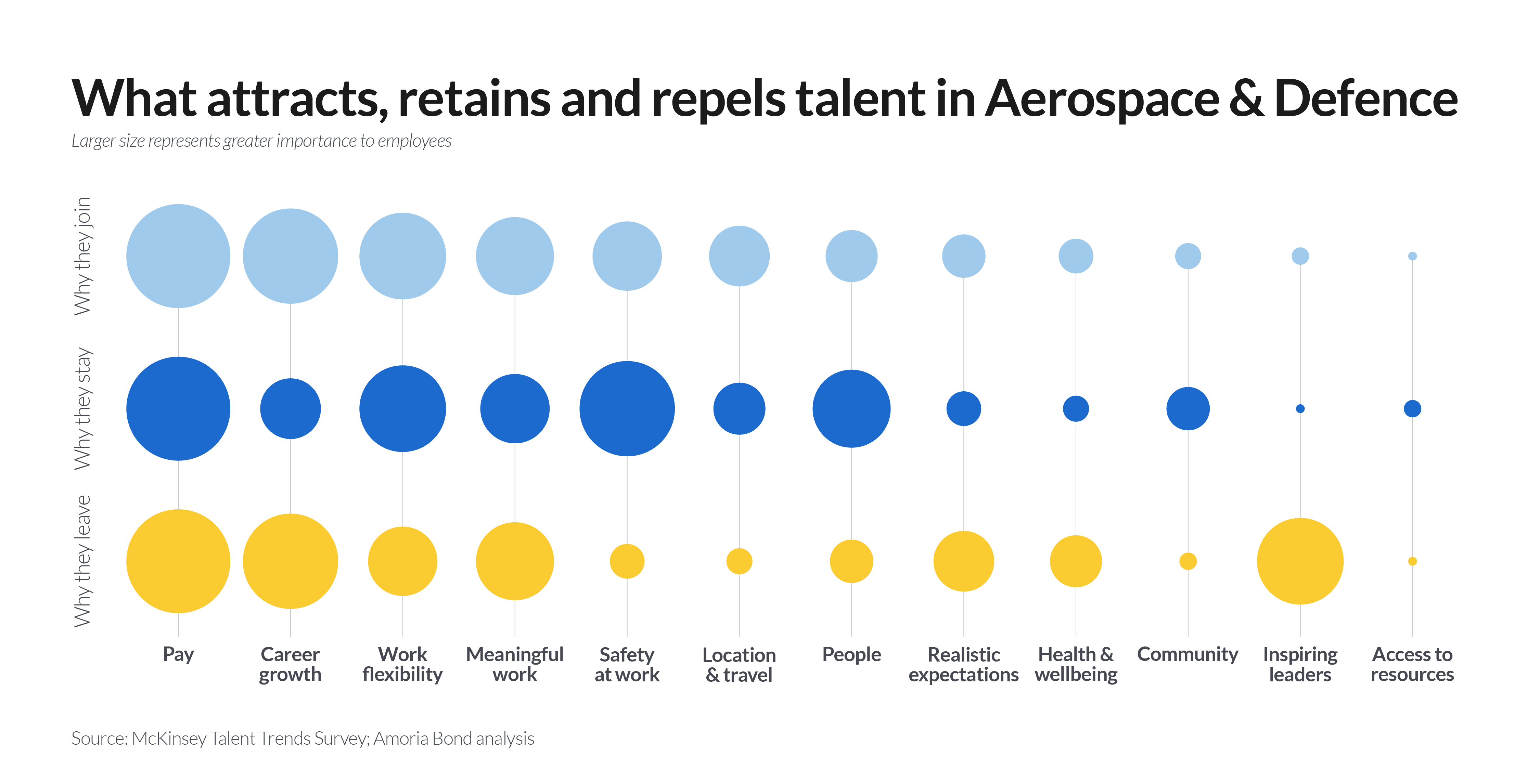
Why is it proving so difficult to attract and retain top talent? European employees in the A&D sector have clear priorities:
- People are drawn in by competitive pay, career development opportunities and flexibility.
- They stay for meaningful work, job security and flexibility.
- They leave due to inadequate compensation, limited development prospects and leadership issues (McKinsey & Company).
Organisations that proactively address these gaps through targeted hiring and reskilling secure a decisive competitive advantage.
Agile Recruitment as a Competitive Edge
The outlook for 2026 is unambiguous. Market demand is strong, the technology is ready — but critical resources are scarce. Companies looking to grow in the aerospace and defence industry must treat talent acquisition with the same strategic importance as product development. This is no longer just about filling vacancies; it is about preventing productivity losses that can quickly reach into the hundreds of millions.
How Amoria Bond Can Support You
In 2026, Europe’s aerospace and defence industry will continue to grow — technologically, economically and geopolitically. At the same time, the skills shortage is intensifying, already costing the sector billions. For hiring managers, this creates a clear reality:
- Those who recruit strategically now will pull ahead of competitors in the race for innovation.
- Those who react too late risk production delays, quality issues and missed market opportunities.
Amoria Bond has been supporting organisations across the European advanced engineering market for many years. We help you secure the best specialists across engineering, AI, manufacturing, systems safety, supply chain and project management — quickly and reliably.
Let’s build teams that are fit for the future of the aerospace and defence industry. Get in touch to strengthen your hiring strategy for 2026.