
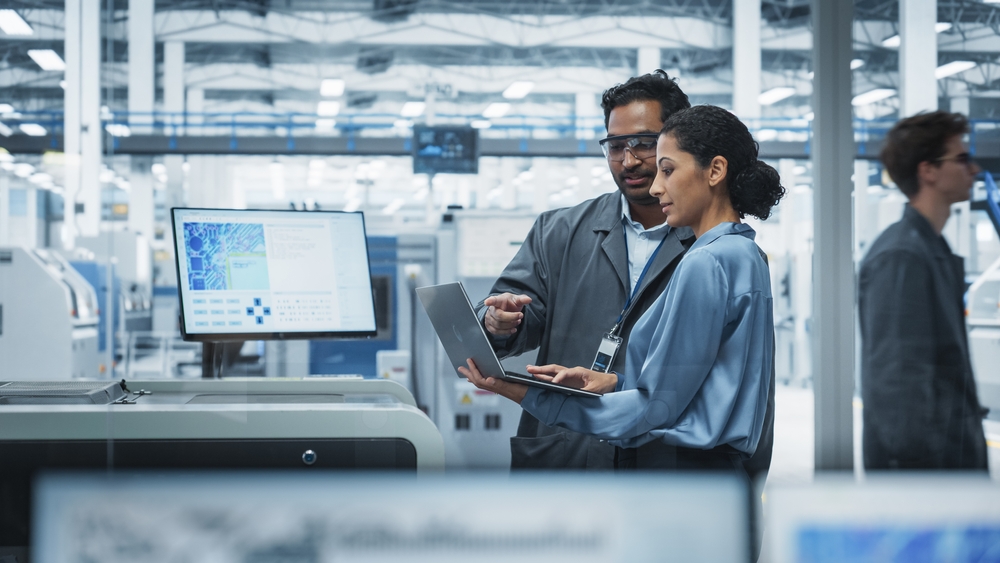
An AI heavy narrative dominates the semiconductor space – hyper-scaling projects have become mainstream news. Everyone has heard the name Nvidia, most of us are aware of the critical strategic role semiconductor production now has. But the AI revolution isn't the only driving force in semiconductor production and the pathways less directly linked to AI are now looking for IT and software specialists just as aggressively as the big-name AI labs.
Dutch giants ASML (Advanced Semiconductor Materials Lithography) who make the lithography machines needed to produce semiconductors and NXP (Next eXPerience) who build chips for automative and industry have both recorded substantial revenue numbers in the last calendar year. NXP's Q2 2026 was its strongest second quarter on record, up 19% year-on-year with management guiding Q3 2026 revenue of $3.75 billion. (NXP, 2026) (MarketBeat, 2026)
ASML software moves are twofold: repeated IP-theft has made cybersecurity and export-control IT roles central to strategic hiring, whereas emerging compute power derived from AI provides opportunity for software to reach beyond the physical constraints of hardware.
What are the main drivers for ASML and NXP heading further into software?
Electrification in automotive has forced fabs like NXP to rethink their chip production, increasingly introducing software on top of the hardware base.
Software is driving the growth in automative with almost 50% of NXPs Q2 2026 revenue coming from automotive, driven by SDV, radar, electrification and connectivity content. This new wave of vehicles is eking out further space for chips plus, a new approach to chip production which emphasises updates and security. (TIKR, 206)
ASML works on a different plane, manufacturing machines which make chip production possible. Given the new capabilities of AI and the restrictions of physics, ASML is leaning on software and AI to continue improving its technology beyond the physical constraints of hardware.
Once you're patterning features a few atoms wide, the machine's mechanical precision alone can't get you there; you need software to predict, correct, and continuously tune the physical process in real time.
What opportunities are now available to IT & software specialists in Europe?
With two major players moving more into software and the EU Chips 2.0 Act published June 2026, the opportunities for specific IT and software specialists skilled in areas like cybersecurity, embedded software, AI/edge compute and export-control compliance are exploding. (SEMI Europe, 2026)
In a landscape of general corporate downsizing across Europe, IT and software specialists are an exception. The EU's first Chip Act put €52 billion into the semiconductor and surrounding industry; Chip 2.0 is expected to go further, including quantum-chip engineering capacity.
That policy tailwind, coupled with shifting demands, means software specialists across the continent are in increasingly high demand and can expect to see wages rise steadily while the shortfall continues. (SEMI Europe, 2026)
How do the opportunities in IT and software differ outside of Europe?
In the US, the semiconductor industry differs to Europe, with a larger emphasis on structural buildouts and AI-data-centre driving demand.
TSMC (Taiwan Semiconductor Manufacturing Company) alone has committed $265 billion across 10 planned Arizona fabs, and McKinsey/SEMI/NSF project a US shortfall of up to 157,000 semiconductor workers by 2030 as AI labs compete for the same graduates. Compared to the EU, the US market is directly exposed to the Nvidia ecosystem (NXP's growing data centre segment) and is also the origin point of the export-control regime that European IT/compliance teams must implement. (TheStar, 2026)
In Asia, there's a meaningful difference from the EU and US, namely less front-end chip design, more packaging, testing and increasingly design services. Malaysia's National Semiconductor Strategy targets $107 billion in investment and 60,000 new skilled workers by 2030; Singapore is positioning itself for advanced packaging and R&D (Micron's $7 billion HBM packaging plant starts operations in 2026); Vietnam is emerging in packaging, testing, and AI chip design specifically. Vietnam and Singapore have even launched a formal talent-exchange programme sending professionals on two-year placements in priority sectors including semiconductors. (Malaysian Investment Development Authority, 2024), (Singapore Economic Development Board, 2025)
So where are the IT roles in semiconductors? The traditional technology hubs, but also a growing number of roles are moving into satellite locations or operate remotely. Here in the Netherlands, there a lot of roles emerging with the nation's technology giants racing for the best talent.
If you're looking for your next opportunity and want to learn more about the roles available or are looking for the right specialist to join your team, schedule a call with me today. With a global network of experienced specialists and a commitment to moving at pace, Amoria Bond is well paced to meet your needs.
References
NXP Semiconductors. (2026a, July 28). NXP Semiconductors reports second quarter 2026 results [Press release]. https://investors.nxp.com/node/24846/html
MarketBeat. (2026, July 28). NXP Semiconductors Q2 earnings call highlights. https://www.marketbeat.com/instant-alerts/nxp-semiconductors-q2-earnings-call-highlights-2026-07-28/
TIKR. (2026). NXP Semiconductors stock surges 26% after Q1 2026 earnings beat. https://www.tikr.com/blog/nxp-semiconductors-stock-surges-26-after-q1-2026-earnings-beat
SEMI Europe. (2026, June 3). European Commission presents Chips Act 2.0 at SEMI Europe Policy Forum to accelerate semiconductor innovation and investment. https://www.semi.org/eu/semi-press-release/european-commission-presents-chips-act-2.0-at-semi-europe-policy-forum-to-accelerate-semiconductor-innovation-and-investment
The Star. (2026, July 10). Chip worker shortfall endangers factory revival. https://www.thestar.com.my/business/insight/2026/07/10/chip-worker-shortfall-endangers-factory-revival
Malaysian Investment Development Authority. (2024, May 28). PM Anwar: Malaysia to train, upskill 60,000 engineers, allocate RM25b in fiscal support for National Semiconductor Strategy. https://www.mida.gov.my/mida-news/pm-anwar-malaysia-to-train-upskill-60000-engineers-allocate-rm25b-in-fiscal-support-for-national-semiconductor-strategy/
Singapore Economic Development Board. (2025). Micron breaks ground on $7 billion HBM facility in Singapore. https://www.edb.gov.sg/en/news-and-insights/micron-breaks-ground-on-7billion-hbm-facility-in-singapore